


Flag football might be a new Olympic Games sport poised to make its anticipated debut at LA28 two years from now, but this summer’s IFAF World Championships will be the 12th such tournament which boasts a proud history dating back to 2002.
IFAF recalls some highlights the men’s competition, which was inaugurated in Vienna and has since been hosted by ten nations on three continents on a biennial basis.
Host Austria claimed that historic first-ever crown with a low-scoring 6-0 victory over Germany, while France edged Sweden 12-6 to win the bronze medal. Austria was enjoying the most successful period in its national team’s history, also claiming the European title in 2003. The dominant Austrians made it three trophies in three years by defending their crown in Thonon-les-Bains, France. Again, victory came against Germany this time by a score of 26-24 and the hosts again claimed the bronze medal, beating Japan 40-23.
The 2006 competition in Korea, brought about a significant change as the previous style of playing 7-on-7 flag football had been replaced by IFAF and then European governing body EFAF by a 5-on-5 format that remains in place today.
Twice a beaten semifinalist, France like Austria before them headed to the worlds in Daegu as European championships and returned home with the world title to add to their haul. Denmark, themselves on the brink of six straight European championships from 2009 to 2019, were beaten 46-32. Thailand broke the European stranglehold on medals and became the first and so far, the only Asian nation to reach the final four, as they beat Austria 45-33 in the bronze medal game.
When the IFAF World Championships ventured to North America for the first time in 2008, it was host Canada that emerged as the first non-European winner. A defensive battle with Denmark was finally broken when Marc Andre Kery scored the winning touchdown in a 12-6 victory. The bronze medal game was a one-sided success for France whose 45 points were unanswered by the United States. But the fourth-place finisher was about to emerge as a major force on the world stage.
Two years after a medal eluded them, USA was back with a vengeance as Canada again hosted the tournament, this time in Ottawa. With quarterback Jorge Cascudo – who is now the head coach of the world champions – at the helm, USA went unbeaten in the group stages and saw off Germany and Canada in the knockout stages. Europe’s finest Denmark was beaten 35-19 in the title game.
“We can’t say enough about our quarterback Jorge Cascudo,” said USA’s John Roberts. “We saw him down in the tryouts in Florida, and we knew he was something special. He is amazing and I am just glad he is on my team and didn’t have to face him.”
The bronze game was a thriller as Italy threw a touchdown in the final seconds to defeat the 2008 champions Canada 28-24.
USA was favorite to repeat at the 2012 IFAF Flag Football World Championships in Sweden, but Austria, the only team at that time to have won multiple titles had other ideas. Gothenburg witnessed a thrilling gold medal game as Austria and USA went toe to toe with Austria edging a high-scoring clash 47-40 late in the game for their third world crown. Three-time silver medalists Denmark added bronze to their collection with a 44-43 win over Mexico.
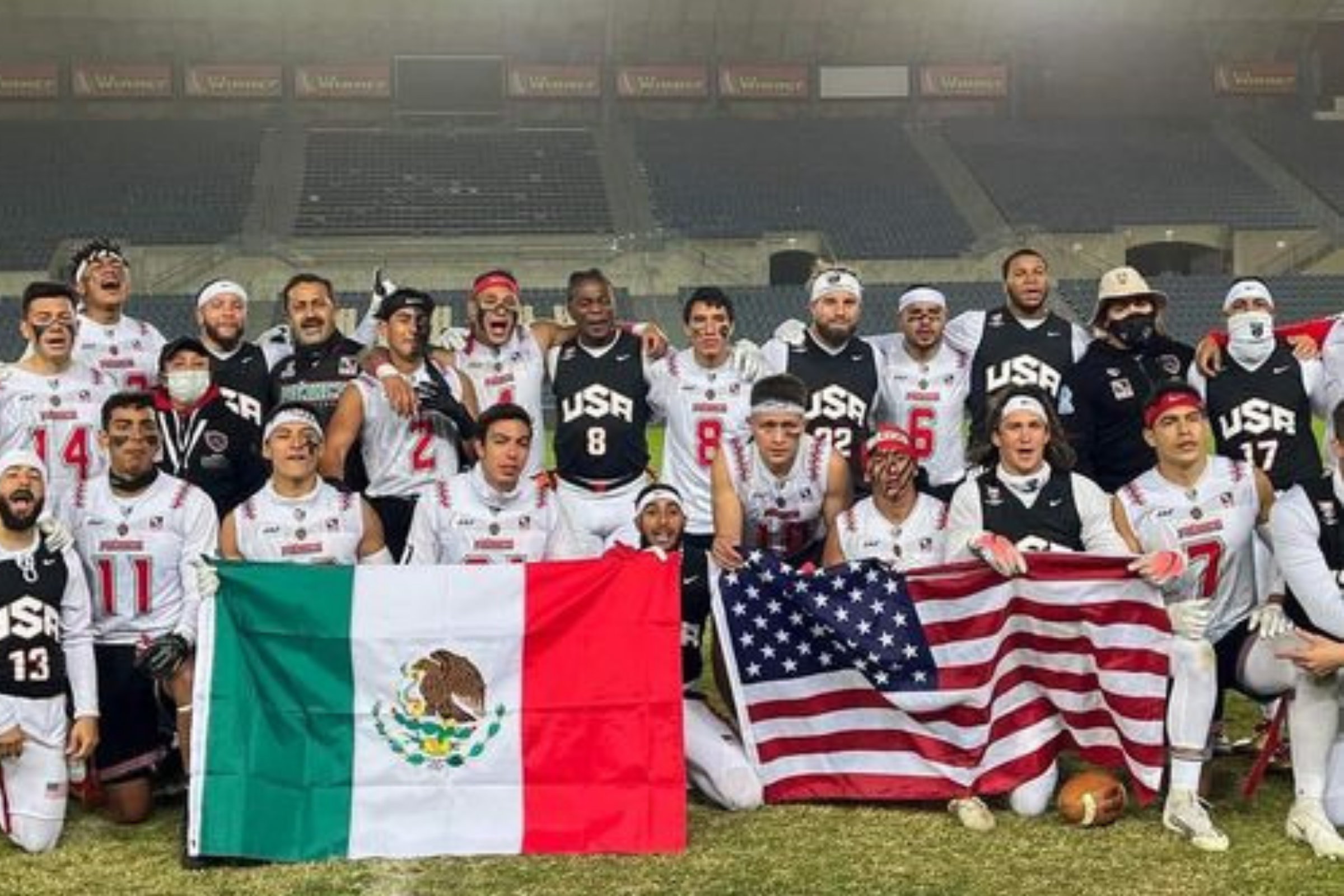
And so began the age of the United States. An unprecedented five straight IFAF world championships began in Grossetto, Italy, where the first title game meeting of a new rivalry saw Mexico beaten 40-14 in the 2014 final. Claiming a third straight world crown was a close affair in 2016 on home turf in Miami. A one-point win denied Denmark a gold medal to add to their now routine European haul as USA matched Austria’s hattrick of wins with a 33-32 scoreline.
Two years later revenge over Austria was achieved in Panama City and having beaten Mexico to triumph in Israel in 2021, the USA-Austria matchup brought the Americans that fifth successive title in Finland in 2024. Italy, Mexico, Denmark, Panama and Switzerland all picked up bronze medals during those years.
The United States sits out front as the most successful team on the world stage with six championships and a silver to their name, followed by three-time champion and two-time runner up Austria. France boasts a win and three bronze medals ahead of Canada’s solitary gold. Denmark has medaled six times, four silver and two bronze while Germany and Mexico have both twice finished as runners-up.
Photo: IFAF