



The National Football League played its first ever regular season game on Australian soil this week as the San Francisco 49ers defeated the Los Angeles Rams 27-7 at the Melbourne Cricket Ground.
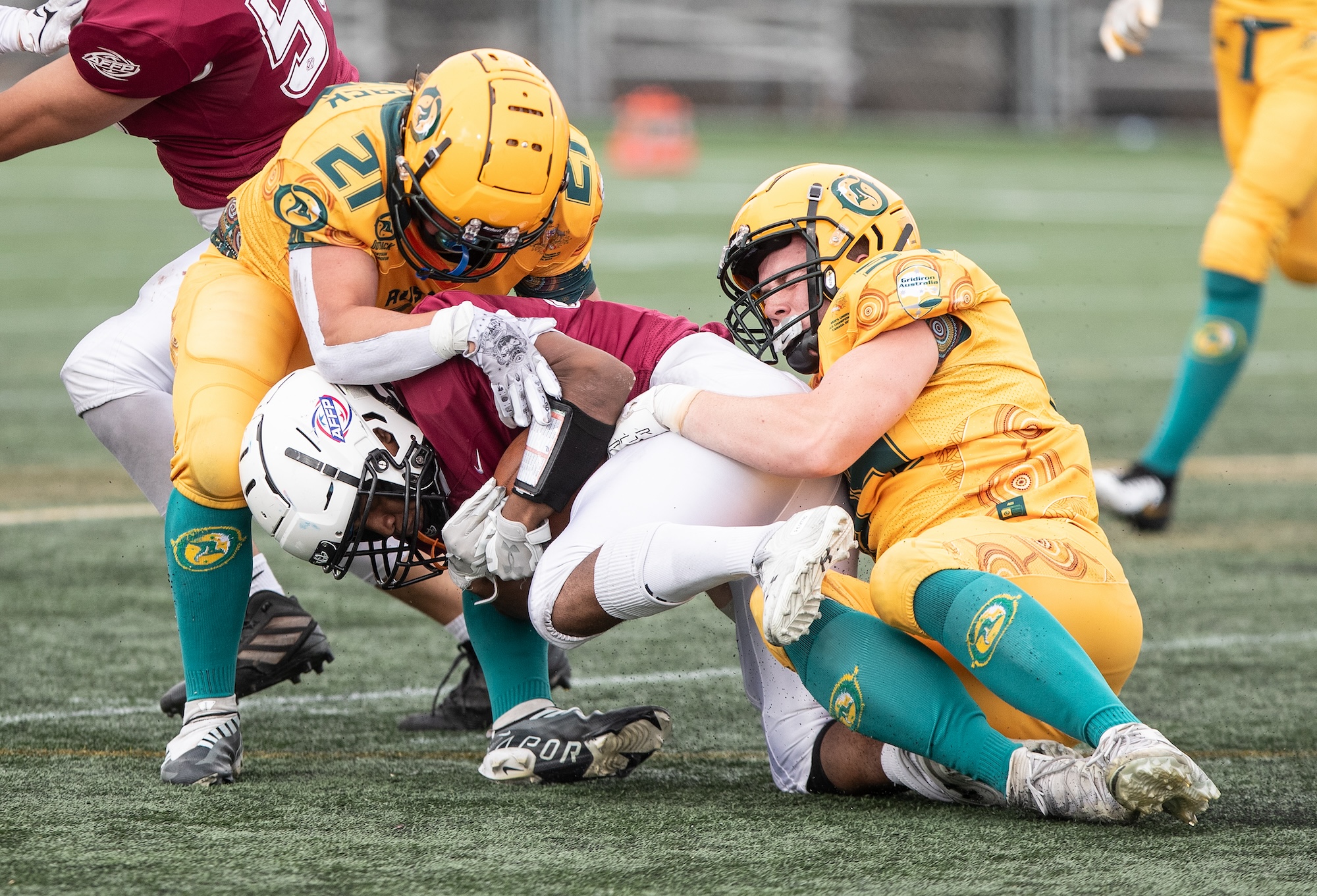
But tackle football down under has been an international focus for the Australians since the first IFAF World Championship was played in Italy in 1999. Australia has consistently battled on the world stage in IFAF men’s, women’s and youth tackle tournaments during the past 27 years.
IFAF Men’s World Championships
The journey began in Palermo, the largest city of the autonomous island region of Sicily as six nations contested the inaugural men’s tackle title. Drawn in group B with Sweden and one of the tournament favorites Japan, Australia’s debut saw them trail Sweden by only four points at halftime before falling to an eventual 22-6 defeat. Japan proved too strong in the second game, running out comfortable 54-0 winners and went on to be crowned the first IFAF world champions.
Playing for fifth place overall, the Australian team drawn from six states was matched against Finland, the 1997 European bronze medalists and continental champion two years earlier. The Finns led 7-0 at halftime, but Australia, under head coach Jim Wagstaff, scored ten unanswered fourth quarter points to return home victorious.
For Australia, whose players had each paid AU$3000 and were required to spend five weeks away from home in 1999, competing internationally was a hardship on many fronts. They missed the next two IFAF world championships but returned to the world stage in 2011 in Austria.
The competition in Group A could not have been more daunting with defending champion the United States, powerhouse Mexico and reigning European champion Germany in opposition.
Australia boasted future NFL offensive lineman Adam Gotsis in their ranks but were no match for a rampant USA in the opener in Innsbruck, going down 61-0 then Mexico were also merciless as they put up 65 unanswered points. Germany were pushed all the way in a 30-20 defeat as Australia’s offense started firing, but host Austria was still smarting from missing out on the medal rounds and won the fifth-place game 48-10 in Vienna.
In 2015 at the Tom Benson Hall of Fame Stadium in Canton, Ohio, the wait for an Australian IFAF world championships victory came to an end. Jared Stegman, who is the current quarterback of Australia’s flag football national team, threw for 133 yards and four touchdowns and Conor Foley ran for 132 yards and a touchdown in a 47-6 thrashing of Korea.
France proved a different proposition and ran out 53-3 winners in the second game, but Australia bounced back with a 16-8 victory over Brazil. A 58-yard touchdown pass from Stegman to Matt Riles opened the scoring then fullback Nate Lansdel went in from four yards out two drives later and put Brazil down 16 after the first quarter.
Australia met Korea again to contest fifth place and raced out to a 14-point first quarter lead. Stegmann completed 8 of 27 passes for 224 yards and a touchdown, and in doing so tied a tournament record of throwing six touchdown passes, while the Aussies scored three rushing touchdowns in the win.
This year the men’s national team took on New Zealand in the Festival of Football hosted by their Oceania rivals and narrowly lost a heartbreaker 36-33
IFAF Women’s World Championships
Australia’s first foray into the IFAF Women’s World Championships game at the tournament’s third edition in 2017 when Canada played host in British Columbia.
A hard-fought 31-6 loss to the home nation was followed by a 31-10 defeat to Mexico then in the battle for fifth place overall, Australia went down 35-0 to Finland.
Five years later, after the Covid pandemic had postponed the next planned tournament, Finland hosted eight nations in Vantaa. Australia was again matched with Canada and Mexico. Against the Canadians, a 33-6 loss saw wide receiver Jordan Di Mizio reel in seven catches for 52 yards and a touchdown before Mexico won 34-6.
Australia ended a five-game losing streak in the tournament with a 7-0 victory over Sweden with the deadlock broken in the fourth quarter by a Casey Byrne 75-yard touchdown run before Marissa Hayes tagged on the extra point. Victory meant Australia finished seventh overall.
IFAF Youth World Championships
At the Under 19 level, having lost a qualifying game to New Zealand for the inaugural IFAF Junior World Championship in 2009, Australia took to the world stage in 2016 in Harbin, China.
Their introduction at the youth level was dramatic with a 72-0 win over the host nation. A traditionally strong Japan team then beat the Aussies 42-0 before a second clash with China saw 74 unanswered points scored. Austria proved too strong in a 43-13 defeat for an eventual overall finish of sixth.
Mexico hosted the 2016 tournament where Australia lost 39-0 to the United States, 19-6 to Sweden and 51-14 to Japan to again finish sixth.
In Edmonton, Canada, in 2024, with the age limit for the teams extended to Under 20, Australia suffered a 50-6 loss to Japan but recovered to beat Panama 21-0 to advance to the fifth-place game. Canada 2 proved too strong with a 45-7 scoreline as Australia finished sixth out of eight teams above Panama and Brazil.
This year the Australian U18 national team took on New Zealand in the Festival of Football hosted by their Oceania rivals and came home with a 34-22 victory.
Australians in the NFL
There is a long tradition of Australians playing in the National Football League.
Darren Bennett paved the way for a string of Australian punters to excel in the NFL. Having played 74 games with Melbourne in Australian Rules football and 102 AFL games in total, Bennett led NFL Europe in punting in 1995 then became a fixture with the San Diego Chargers, earning Pro Bowl honors. He was named to the NFL’s 1990s All-Decade Team.
Paul Manera was the first Australian to earn a full college football scholarship in the United States. He played for three seasons at the University of Hawaii on the offensive line then returned home where he was an assistant coach on that first Australian men’s team to compete at the 1999 IFAF World Championships. Manera was the first-ever coach of Australia’s women’s flag football national team in 2023.
Jordan Mailata had been a Rugby League player in Australia before he developed from being a seventh-round NFL Draft pick of the Philadelphia Eagles in 2018 to win Super Bowl LIX while regarded as being among the best offensive linemen in the NFL.
Jesse Williams represented Australia and the IFAF World Team at American football then went on to win two national college football championships at the University of Alabama. The defensive lineman became the first Australian to win a Super Bowl ring as a member of the Seattle Seahawks squad that lifted Super Bowl XLVIII.
Photo: Jason Franson