



Many sports covet a pathway that guides former players and coaches into an officiating role, the logic being that an athlete who has played the game at the highest level is ideally suited to refereeing the sport from a unique perspective. Very few sports have succeeded in enticing their athletes to make the transition.
Back in the mid 2000s, there was skepticism within the American football community when former San Diego Chargers and New England Patriots All-Pro safety Rodney Harrison took the first steps down that route. Twice named the dirtiest player in the NFL, Harrison enrolled in an officiating initiative during NFL Europe training camp as the trajectory that had developed several players for NFL teams attempted to do likewise for those wearing black and white uniforms on any given Sunday. Harrison instead followed a successful path into broadcasting.
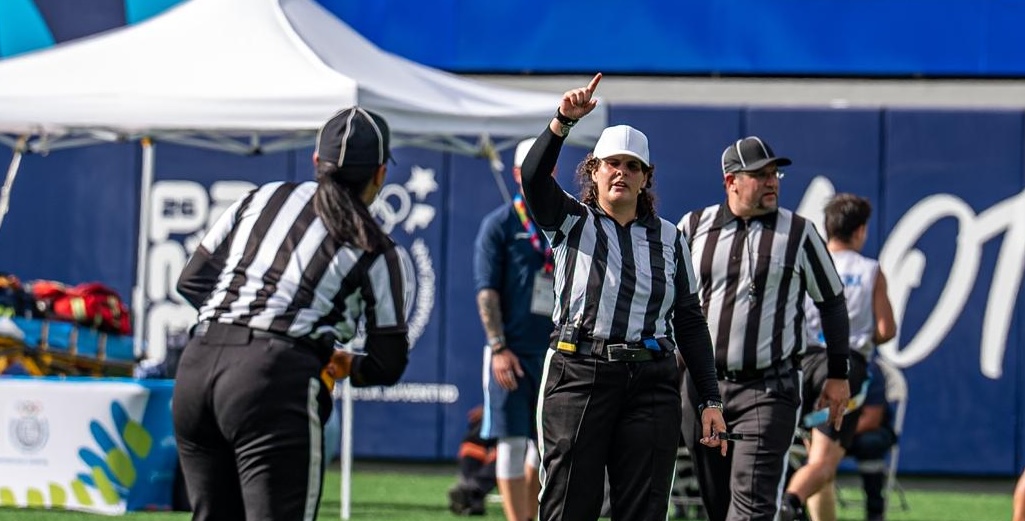
By contrast, flag football is already seeing several former players taking those steps from once chasing victories and championships to making calls on the field of play. At the recent IV South American Youth Games Panama 2026 in April, two Panamanian officials who have won an IFAF world championship and one who played for and coached Brazil took charge of U17 Boys and Girls games.
Ana Cazarin represented Brazil at the 2016 IFAF World Championships in the United States then retired as a player to become the offensive coordinator of her national team at the 2021 tournament in Israel and at The World Games in 2022. She led Brazil at the 2024 IFAF World Championships in Finland as head coach then a year later made the switch to officiating.
Cazarin made her officiating debut at the IFAF Americas continental championships in Panama last year and then returned for the ODESUR youth games in April. She believes prior her experience on the field is a definite advantage and has discovered that the different elements of the sport all have their own nuances.
“It helps a lot because I can understand what the offense or defense are trying to do, so I can predict what the players are going to do,” she explained. “I also know the little things that players do that they don’t want officials to see!
“I think (my old teammates and opponents) like that it’s nice to have someone familiar and there is also a different respect between the players and officials as a result. It is easier when you know the athletes personally.
“It isn’t easier to be an athlete, but it is more natural because you just go out on the field and play. In coaching there is more preparation and more pressure and you’re not on the field. You can only watch and coach. Officiating I really like. I just like to be part of the game and still be here on the inside. I love everything about flag football.”
The transition required Cazarin, who was inspired to first play flag football after she watched the New Orleans Saints win Super Bowl XLIV, to detach herself from former teammates and players she had coached.
“It was difficult at first because the players are my friends and I learned the game with them,” she said. “So, I tried to have an approach that separated me which was not easy. I was relatively young, but it went well and now I can see how well they’re doing while focusing on my role as an official.”
Cazarin has seen a transformation in flag football from when she began her journey to the sport being included on the calendar for the Olympic Games at LA28, particularly having observed how things have developed in her home nation.
“The Olympics changes everything because now we have the support or the Olympic committee from Brazil,” she added. “The practices are much better, and we have more financial support than before to travel throughout Brazil which is a big country.
“In Brazil, I often still have to explain what flag football is, but many people are intrigued or they have seen it on TV. Now more people are starting to hear about flag football. It’s a perfect sport for Brazil because it’s very playful and we love that. I think that as we reach more people, we will become more successful.”
Cazarin is also consumed by flag football in her job as a flag football teacher in schools, introducing her sport to Brazilian youngsters aged between eight and 14. When she pulls on her officiating uniform, she has two simple goals.
“I would like to officiate more IFAF events and improve as an official as I did as a player and a coach,” she said. “I would like to say the Olympics are my target, but we will have to see how I progress.”
No matter how Cazarin’s flag football career progresses, it will inspire other to play, coach and perhaps later officiate the sport they love.
Photo: AFFP