


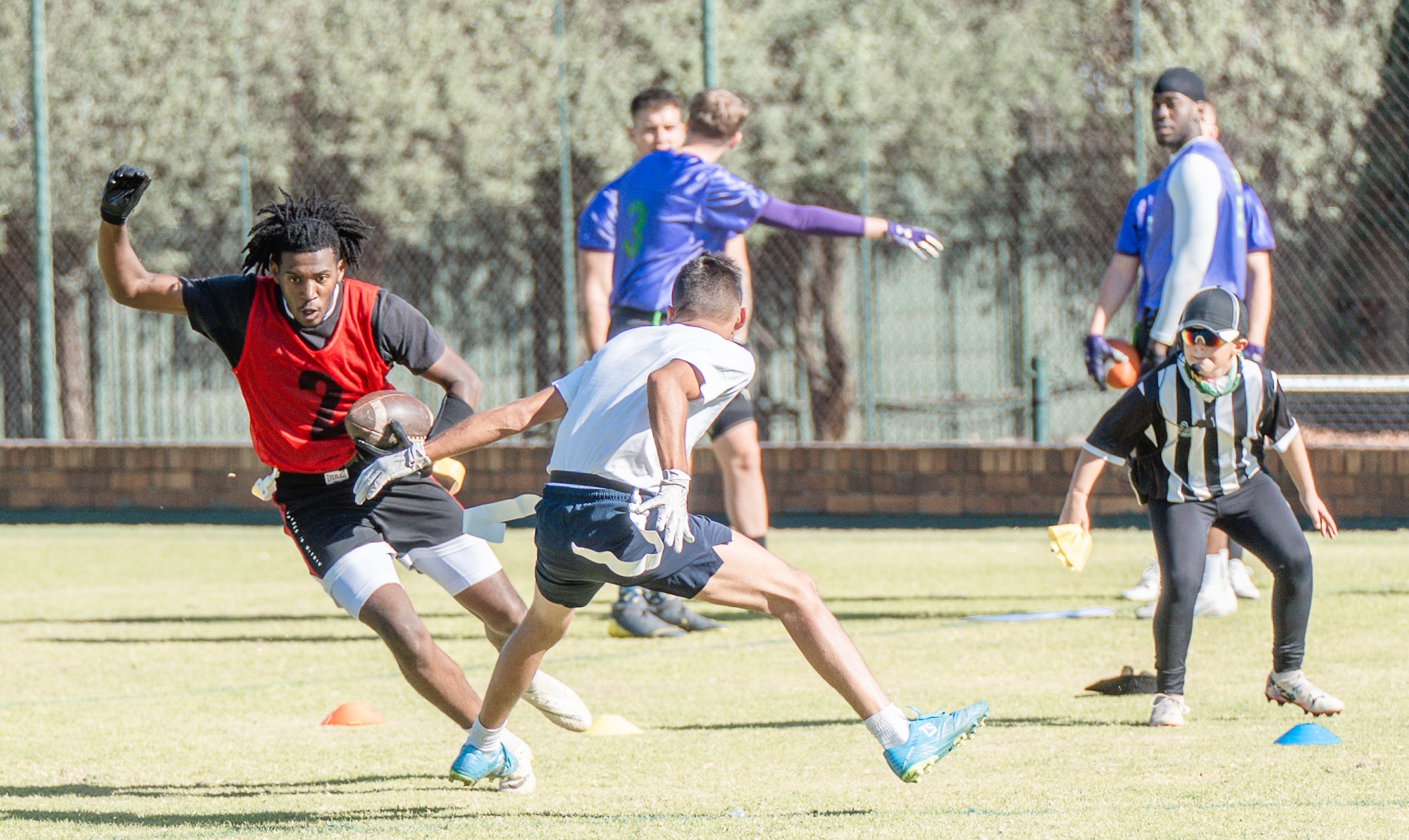
South Africa will travel about 8,300 kilometers to Cairo – further than any other nation – flying more than eight hours to compete at Africa Flag 2025.
Head coach Anthony Shelton was a two-time national flag football champion with the University of North Carolina Charlotte in his home state and now works as a sports consultant in Johannesburg, focusing on sport development and coaching basketball. He directs the fortunes of his adopted nation from Johannesburg, aiming to make history at the inaugural African continental championship.
“When flag became a little bit more popular here, I gravitated to that and really thought it was a viable option to become South Africa’s coach, with my background in basketball and American football,” he explains. “In my experience basketball players make great flag football players so I was able to attach the two together.
“Adding flag football to the Olympics drew about more interest in flag here. With rugby being so popular in South Africa there's a lot of interest in the contact side of American football, but that’s expensive and with equipment it becomes really out of reach for most countries outside of the West.”
As a result, South Africa will arrive in Cairo with a combination of flag and tackle football players, along with those whose roots are in basketball and one of the nation’s traditionally most popular sports, rugby. And they have a gameplan.
“We want to be very methodical in our approach,” says Shelton. “We've got players that can do some flashy things but I'm sure every other team has the same, so we're just trying to establish a good a good offensive rhythm. We want to be solid on defense where everyone knows their assignments.
“Our offensive schemes are not going to be based on the results of a previous play. We've got a game plan and we’ll be very intentional and tactical in our approach.”
Open tryouts were held around the country in the Western Cape, Free State and Gauteng provinces with approximately 50 attendees. A group of evaluators then made recommendations with coach Shelton, who now has offensive and defensive coordinators as part of his staff, making the final selections.
“Because it's a relatively new sport, the pool of players is smaller than maybe you would like, so we had open trials rather than just pull from the players that were already participating in flag,” Shelton says. “We wanted to give the opportunity for players that maybe had never even tried just to come out and see what they've got.
“We have guys that have been playing for six, seven or eight years and some that have been playing for only three or four months that are just gifted natural athletes and picked up on the sport quickly. There were a few gems and there was a guy that we didn’t know but he was blazing fast and didn't drop the pass and he's a relative unknown. That was just cool to see.
“It was really exciting to see that come together and one thing that was really important for me was just developing a positive culture, not just selecting the best athletes but trying to find guys that were willing to buy into the long-term vision.”
That vision begins with the quest for the gold medal at Africa Flag 2026 which in turn would earn a place at the 2026 IFAF Flag Football World Championships. The 2028 Olympic Games in Los Angeles is the ultimate goal, along with a sustainable long-term plan to develop flag football in South Africa.
The IFAF member federation has already established a youth flag football league, and an adult league is underway. Introducing the sport to youngsters through school programs will be another critical step, along with the formation of a women’s national team.
“We want to ride this wave of momentum, this excitement that's building, and not just come back from Egypt and let it falter,” he explains. “We're wanting to use this as a springboard into another phase. You can't build a house from the top down. We really need to have a solid foundation.”
That foundation will be cemented in Egypt with an opportunity to develop and attract athletes from among a watching population of 63 million people across South Africa.
Photo: Gridiron South Africa