


Austria heads to The World Games in Chengdu and the IFAF Euro Flag 2025 in Paris as the top ranked European nation, hoping to win a first medal in an IFAF women’s competition since 2021.
In 2024, head coach Robert Riedl returned to the helm, having orchestrated his nation’s fortunes between 2008 and 2016. During that time, Austria won four consecutive gold medals at the Euros and in the World Championships were beaten finalists in 2016 having claimed third place at the 2010 and 2014 tournaments.
Riedl’s return almost brought reward in Finland at the 2024 IFAF Flag Football World Championships, but a one-point loss to Japan denied Austria the bronze medal.
Now they face current world champion USA, an improving Canada team and an unknown quantity in hosts China at The World Games in Chengdu from August 14-17.
“If you are fourth in the World Championships, your goal is to get a medal from The World Games and from the Euros,” says Riedl. “Now it’s our second year with players who have been successful who will only get better.
“Our overall goal is to qualify for the Olympics in 2028, so these competitions are steps towards that. We know we need to be in the top three of the World Championships in 2026 and we want to play at the highest level and compete for a medal.”
Riedl anticipates sending two different squads with some crossover among players to The World Games and Euro Flag 2025 to both compete and determine Austria’s best 12-player squad for next year.
Austria held an open tryout for new players in March having cast an eye over a larger pool in 2024 that included existing players. A total of 28 players, plus the 12 from who took fourth place in Finland created a group of 40 that was cut down to 25 active players who can scrimmage in preparation for this summer’s two tournaments.
“I’m very pleased that I have a really good coaching staff, much more than the two-man show than it was when I first coached the national team,” says Riedl, who has only ever played and coached flag football, and is not a convert from tackle. “I consult more than I coach because the coordinators call their own plays and run the offense and defense. I focus more on the bigger picture. My goal is to have an environment where the coaches and players can play at the highest level.”
Austria’s opponents at The World Games range from one opponent whose credentials are beyond comparison to a team in transition and a complete unknown. The United States are three-time successive world champions, Canada has a new head coach and selection process, and host China enters IFAF competition for the first time as Austria’s first challenge.
“We have no clue about how China will be, so it will be interesting to see how they can compete in such a short amount of time,” explains Riedl. “I am really curious to see them play. We won’t have time to scout them so that will be a challenge for our coaches to react to what they bring to the game.
“USA is going to be really tough. I remember the years when I was coaching from 2008 to 2016. They got better, but they never really had camps or anything like that before tournaments, but now they seem to have thousands of players to choose from and are very well organized.
“Canada we will see before we play them, so we will scout their game and make our gameplan.”
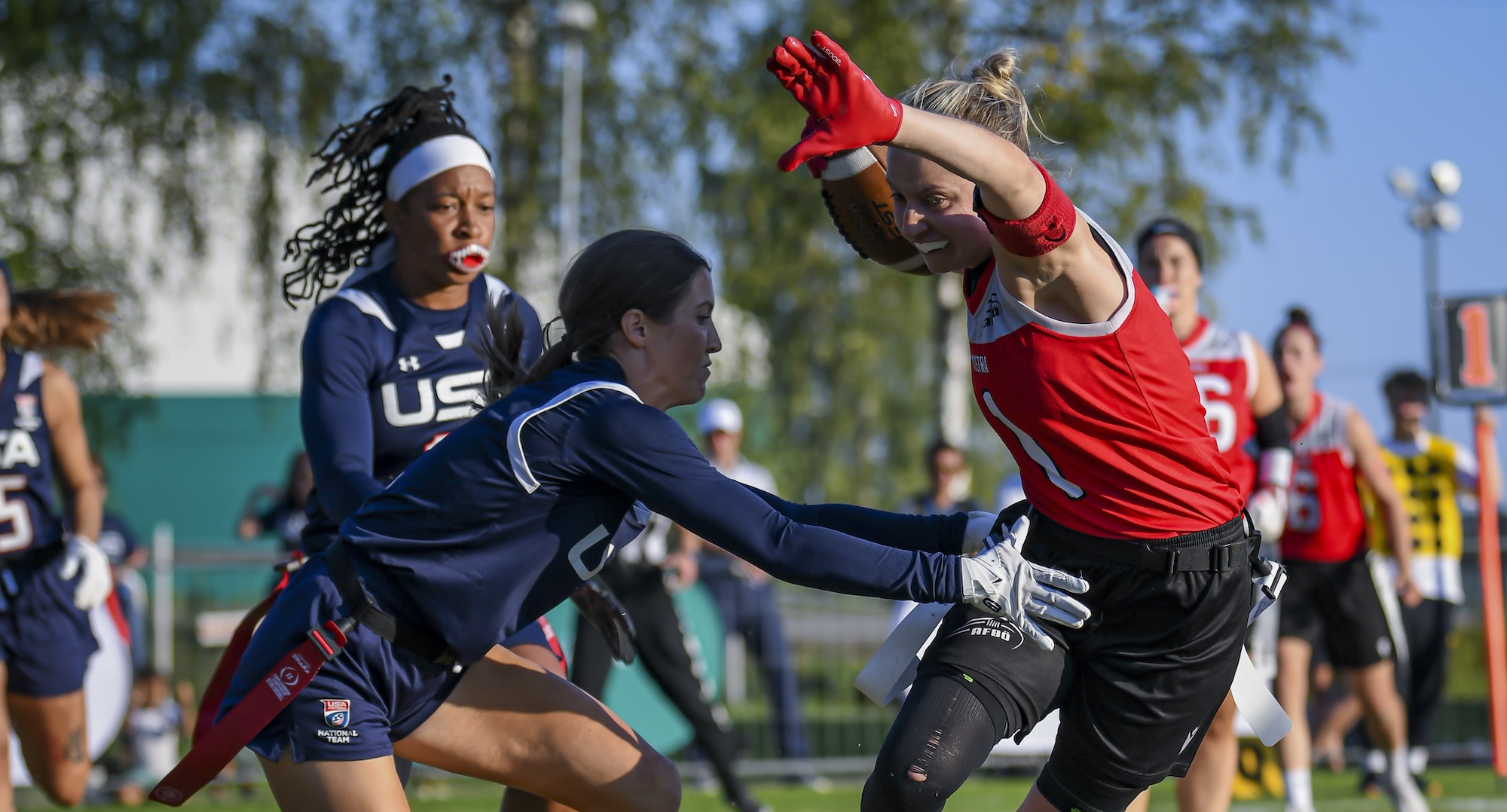
Austria was knocked out the world championships by the United States last summer, losing 41-24 in the semi finals. It was part of the learning curve for this generation of Austrians and one Riedl hopes will serve as a means to create a shock in Chengdu.
“Last year we didn’t perform as well as we had hoped and they made no mistakes, so we couldn’t really keep up with them,” he says. “I’m convinced that we are not that far away, but we need them to have a bad day and for us to play our best and take our chances.”
Photo: Ernesto Campuzano