



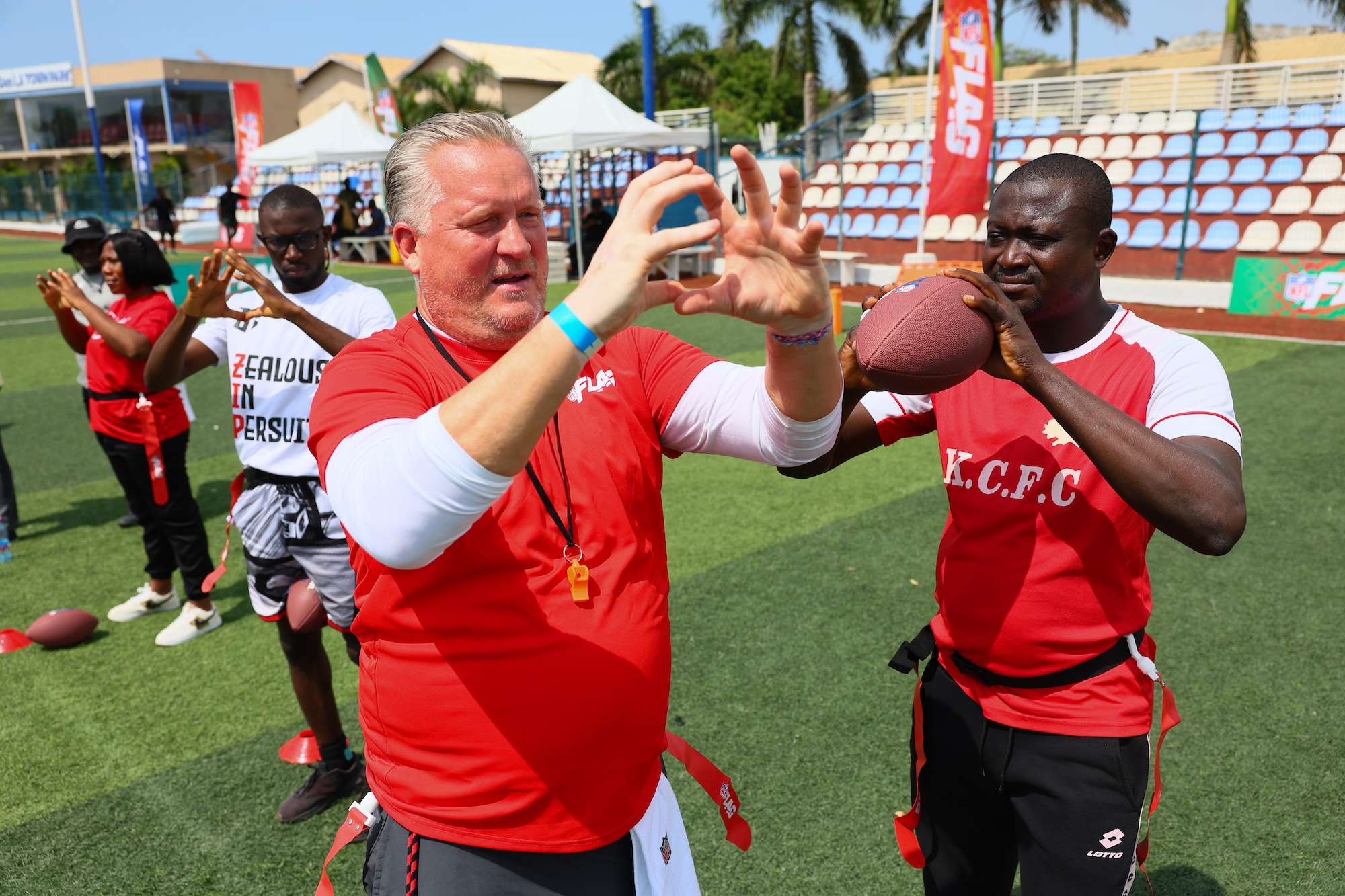
IFAF and the NFL will undertake a joint initiative to develop flag football coaches and officials on the African continent when Ghana hosts a clinic to teach the fundamentals of the sport from April 11-13.
First as part of the NFL Flag program in Africa, a teacher training day will introduce educators to flag football. Then a group of 50 men and women from 10 African countries - Cameroon, Egypt, Ghana, Ivory Coast, Kenya, Morocco, Nigeria, South Africa, Tunisia and Uganda - will receive coaching instruction and training.
At the forefront of spreading the appeal of flag football during the clinics is Hamburg-based Max von Garnier, an experienced instructor and well-respected player, coach and devotee of the game in Europe.
Max has been involved with American football for 37 years, playing for 21 of those at the highest level in his native Germany, representing the men’s national tackle team for 11 years, and winning World and European championships.
IFAF fired a handful of questions at Max before he headed to Ghana to teach teacher and coach coaches who will in turn become instructors in their own countries, enabling a growth of coaching in Africa to meet the upsurge in interest in playing flag football.
How did you begin coaching flag football at a time when you were enjoying success in tackle football?
“I was already coaching flag football with youth teams in Hamburg while I was still playing as well as coaching the Under-19 national team.
“Three years ago, I started an NFL flag school program in Germany, and I have been the lead for everything that happens on the field. We have a bigger team doing all the project management and doing everything around the field, but everything that happens on the field for tournaments, for teachers’ education, for camps is going through me.
“We had a test pilot in 2019 in Hamburg but in 2022 we started a school program in Germany and since then it just got huge. We have educated more than 500 teachers, and 40,000 kids play and enjoy flag football in nine areas in Germany as a result.”
How will that experience translate into running a successful coaches’ clinic in Ghana?
“Rather than coach players the game, you want to teach the teacher so that's basically my job at the moment. We want to turn school sports teachers into flag football coaches and it's not just explaining to them how the game works or how the individual techniques work. We will get them excited about the game and show them that this is a very fun game that the kids will absolutely love. Girls and boys can play together as a non-contact version of American football.
“It is challenging because we have to teach all those individual techniques like throwing the football, catching the football, pulling the flag, doing a snap or a handoff. Those are all techniques that we are individually teaching the teachers, but we also want to get them really excited to try this amazing game.
“I’ve seen how this works 500-plus times. The teachers sometimes are a little bit skeptical and they don't know what to expect, but they talk to me after the workshop, and they are ready to start tomorrow. This is exactly what we want. They want to start with their kids as soon as possible. I usually find that they work hard on all the drills, but they also want to play the game a little bit themselves. So, this is this is an amazing opportunity.
“I always do this with high energy and get them really excited. Since there will be 50 teachers, two of us - me and to Toshane Boyce from the UK team who's also doing the teacher education in the UK - will split the group up so that it doesn't get too big. We will do pretty much simultaneously the same thing on each side of a football field. It’s going to be great.”
What are some of the challenges you expect to face, working with a group that includes people experiencing flag football for the first time?
“The first thing that they have to do is just open their mind and be accessible for new information, not only techniques, but also the rules of flag football. I think the most challenging part is the amount of information that you have to transfer, and not to do it too fast. Explain something, show something, then do something. Let them repeat those things and then move on. If you're too fast you might lose them along the way.
“Once it’s all taught - throwing and catching, the snap, pulling the flag – we will put everything into practice with a lot of fun and excitement. We put these puzzle pieces together and then we create an offense out of the snap and the pass and the catch. We can put the defense together, showing them how to cover someone and how to pull the flag. This will build up not only the understanding of the game but also being excited about individual parts.
“We will make it clear that not everybody has to be able to throw the ball well and play the quarterback position. If a player is more excited about pulling flags, they might be good on the defensive side of the football. The coaches have to be able to show players that there's so many different techniques and positions that anyone can find a role that suits them.”
When you have held similar coaching clinics in Germany, how have you been able to retain interest going forward, to ensure coaches keep coaching and players keep playing?
“Whenever I talk to whoever was at the workshop or I call a couple of teachers that I haven't heard from for a while like to ask if they are still playing flag football, their response is positive. They’re not only playing flag football, they also have it in the curriculum and perhaps 500 kids in their school play flag football every year.
“If you want them to keep playing you have to make sure that they understood the game in the first place and that they feel comfortable teaching the game. So, our job is not just to teach the game and let them know how this works but we also have to show them how to teach their kids this game. Once we've accomplished that and they’re comfortable with how to deliver a technique, how to read a playbook and how to call the play and how to set up an offense, we are successful. If they feel comfortable, they will definitely keep coaching, teaching and playing.”