


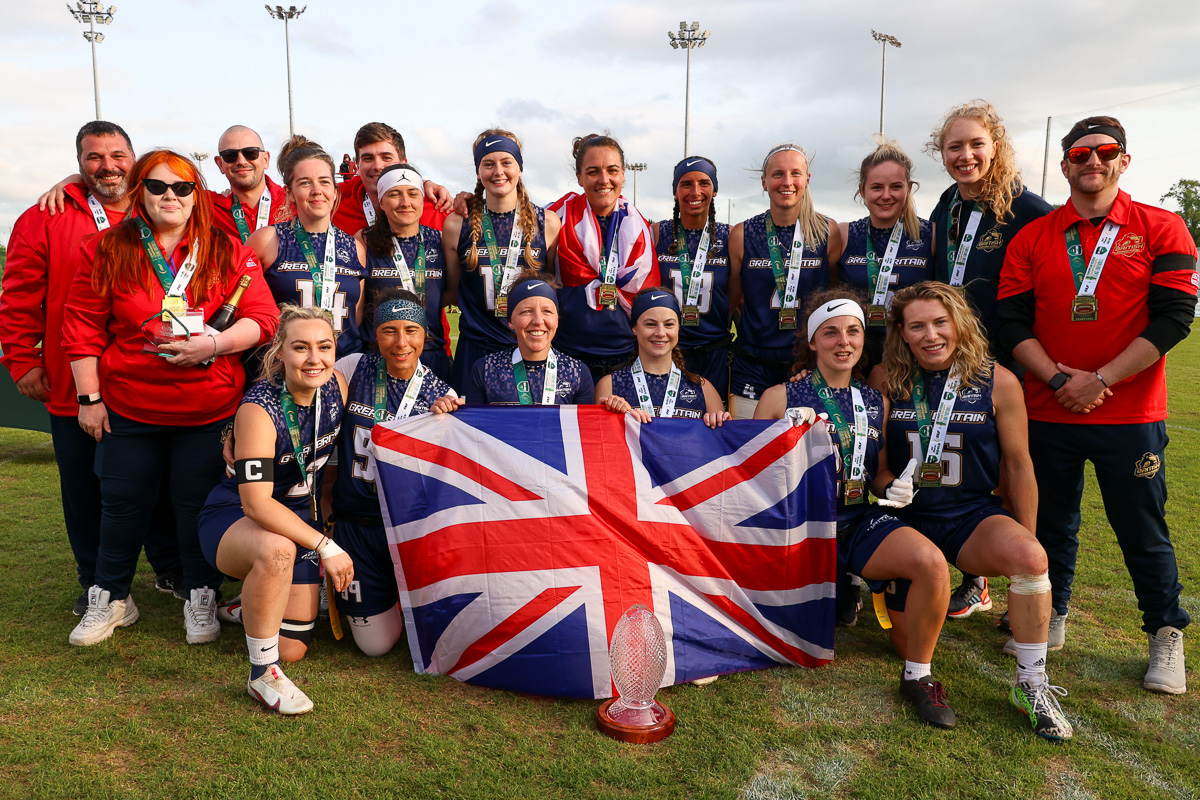
The future success of the reigning IFAF women’s flag football European champions now rests on different if familiar shoulders.
Jack Reed, the Great Britain offensive coordinator at the most recent continental and world championships, has taken over head coaching duties since Dean Whittingslow stepped down from that role.
Jack (pictured far left) is no stranger to the IFAF community having served as IFAF Development Manager and USA Football’s Manager of International Programs between 2007 and 2013. His flag football successes range from founding a youth league in his native Leominster, Massachusetts, and guiding teams to multiple regional, national and NFL Flag championships, to coaching Panama’s women to a bronze medal at The World Games in 2022.
As he did in Panama, Jack will retain the role of offensive coordinator, calling plays in addition to the wider responsibilities of a head coach.
“I really embraced the role of focusing on the offense and the biggest change in becoming head coach is that I need to be concerned with everything regarding the program,” he explains. “When Dean stepped down, I felt that it was important to keep continuity within the program, so when they asked me if I’d be interested in being the head coach, I definitely was.
“Our mission is to build the right culture for us to be successful. We’re going to spend a lot of time on that and be really intentional about the culture that we built within the team. That is going to be largely player driven but it takes a full team of everybody buying into what that culture is and what’s important to us.”
The distance across the Atlantic Ocean from Jack’s home base on the U.S. east coast to his adopted nation is not an obstacle that stands in the way of his determination. The advent of virtual communication and organizing his time efficiently eliminates any potential issues.
“Not living in the UK means it’s just the time and expense that it takes me to travel over there that is the challenge,” Jack says. “I think that the schedule is set up well where essentially, we have one camp per month so we’re talking about one weekend trip per month. The only challenge with that is having to fly in on Thursday night to arrive there Friday morning and then we don’t have camp until Saturday so it’s just a long few days, even though it’s a short flight. With the way the schedule works we’ve been very productive between camps with Zoom calls and video sessions.”
In Limerick in 2023, Great Britain were crowned European champions, posting an 8-1 record, but were unable to transfer that success to the world stage, finishing seventh at the IFAF Flag Football World Championships in Finland last summer. GB qualified for The World Games to be played in Chengdu, China, this August and aim to compete for a medal.
“I think that the seventh-place finish was disappointing,” Jack admits. “We had higher expectations but there were a lot of really positive things that came out of that.
“It was the first World Championships that Great Britain women had ever participated in, we had the first victory over a non-European team with our pool play win against Panama, and when you look at the results, we were a play away from beating Japan and Canada. We didn’t make just a play or two that we needed to make to be competing for a medal.
“We know that we are better than a seventh-place team so our goal at The World Games is to prove that. Then certainly with the European Championships our goal will be to defend the gold medal.”
That sounds like pressure, but Jack doesn’t see it that way.
“I definitely feel the gravity of the situation, like I did when I was named head coach in Panama, but at that time flag football wasn’t an Olympic sport,” he says. “The Olympics wasn’t necessarily on too many people’s radars whereas now I’m taking over as the head coach of a program in a sport that’s in the Olympics. This is a program that aspires to be in the Olympic Games, so I definitely feel the gravity of the position, but that’s why I’m here.”
Jack’s connection with the push to have American football integrated into the Olympic movement goes back to his previous IFAF and USA Football roles. He was part of an IFAF team that earned provisional recognition from the International Olympic Committee in 2013. Now, he hopes to take another step on that journey by ensuring that Great Britain qualifies for the 2028 Olympic Games in Los Angeles.
“That would be a dream come true and in the sport of flag football right now in the coaching profession there’s nothing bigger than the Olympics,” he says. “There’s not a professional league right now, flag is in some colleges, but the Olympics is really the pinnacle. With it being in the United States in Los Angeles it’s a personal goal of mine that I’ve had even before the announcement was made because I was confident that our sport would be included.”
For that dream to become a reality - and for Great Britain to go for the ultimate gold – the women’s team will need to establish themselves among the world’s best. There is also a need to increase squad depth by addressing player recruitment and development. Such challenges bring up that word again: pressure.
“I don’t necessarily view it as pressure,” insists Jack. “I think that what we’re aiming to do is treat this as an Olympic development program.
“I think the challenge for us right now is building a pipeline of players. There’s not a deep pool of flag football players in Great Britain, so we have to look at all different ways to increase that, whether it be getting new people to play flag football or getting elite athletes from other sports. We’re going to be looking at all of that.
“We’re in a unique spot right now where I believe our best can compete with anybody in the world, but we have to take steps to secure the future of the sport in Great Britain.”