


The Japanese sidelines will feature a familiar figure in head coach Makoto Ohashi who returns to take charge of his nation’s U20 squad at the IFAF World Junior Championships in Edmonton, Canada.
Ohashi, the current head coach of Chukyo University Eagles, was the defensive coordinator of the Japan team that participated at the 2018 edition of the IFAF tournament in Mexico, having been the assistant head coach two years earlier in China.
He played football at Tokyo Metropolitan Nishi High School Owls then with the Waseda University Big Bears and Recruit Seagulls, becoming the Seagulls’ head coach in 2000. He led the team to national championships six times, including four consecutive victories from 2010 to 2013.
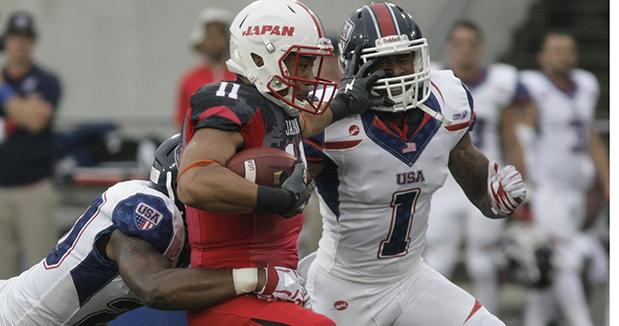
Japan won the bronze medal at the inaugural 2009 IFAF U19 Junior World Championships and finished third again in 2012, but in 2018 two tough defeats to Mexico and Canada led to them finishing outside the medals, though they bounced back with a win over Australia. This year, coach Ohashi is determined to aim for the gold medal.
“I want to fully demonstrate our team’s characteristics and win this tournament,” he said. “It is necessary to acquire the stamina to continue demonstrating speed and quickness until the end of the game, increase the amount of exercise until the very end, and fight in a way that allows the opponent to be at our mercy.”
Japan held tryouts in March and selected 100 players who are poised to attend a second opportunity to earn their place on the final roster, which will be announced on May 24. Players either submitted their own application to be considered for the national team, or their coaches made recommendations and shared video footage of the players in action.
Assembling a national team can pose challenges, though coach Ohashi believes the increase in the competition’s age group from U19 to U20 will prove beneficial.
“There is a large disparity between the environments of players who receive appropriate coaching and those who do not,” explained coach Ohashi. “There are many players who are excellent athletes even if their football skills are still immature, so we must be careful not to leave out such players.
“I believe that being able to select players who have a lot of experience with contact will be a plus. Raising the age also made it easier to recruit players who didn’t have an experience of contact sports until high school.”
Japan’s roster traditionally features players whose speed and quickness compensate for a general lack of size compared with most opponents. Over the years, spectacular quarterback to wide receiver connections and acrobatic plays in the secondary have excited fans.
“It is true that our players are smaller than players from other countries,” agreed coach Ohashi. “And I’m thinking of a way to fight that means our size is our strength. What kind of player you are, rather than what kind of play you can play, determines true victory.
“In 2018, our players improved significantly in a short time by playing hard with excellent players of the same generation in Japan and competing against great players from other countries.”
As for the anticipated strengths of his team and the challenges likely to arise against opening game opponent Australia and potential future match ups, coach Ohashi has clear expectations.
“We want high discipline based on autonomy, and courage from our team,” he said. “(The other teams are) a completely blank slate now. I will collect as much information as I can, but first I want to focus on building my own team without any preconceptions.”
Japan lines up against Australia on Saturday, June 22, at 4pm local time at Clarke Stadium in Edmonton (7am Sunday, June 23 Japanese Standard Time / 8am Sunday, June 23 Australian Eastern Standard Time). The Asia-Oceania rivals have met twice previously at the U19 tournament level when Japan won 42-0 in 2016 in Kuwait, having blazed to a 22-point first quarter lead, and 51-14 in 2018.
The winners in Alberta will face either the United States or Panama, with the losers facing the losing team in that game. Japan and Panama have never met in international competition, while Japan has faced the United States twice before, losing 43-0 in 2014 in Kuwait and 50-20 in the 2016 semifinal in China.