


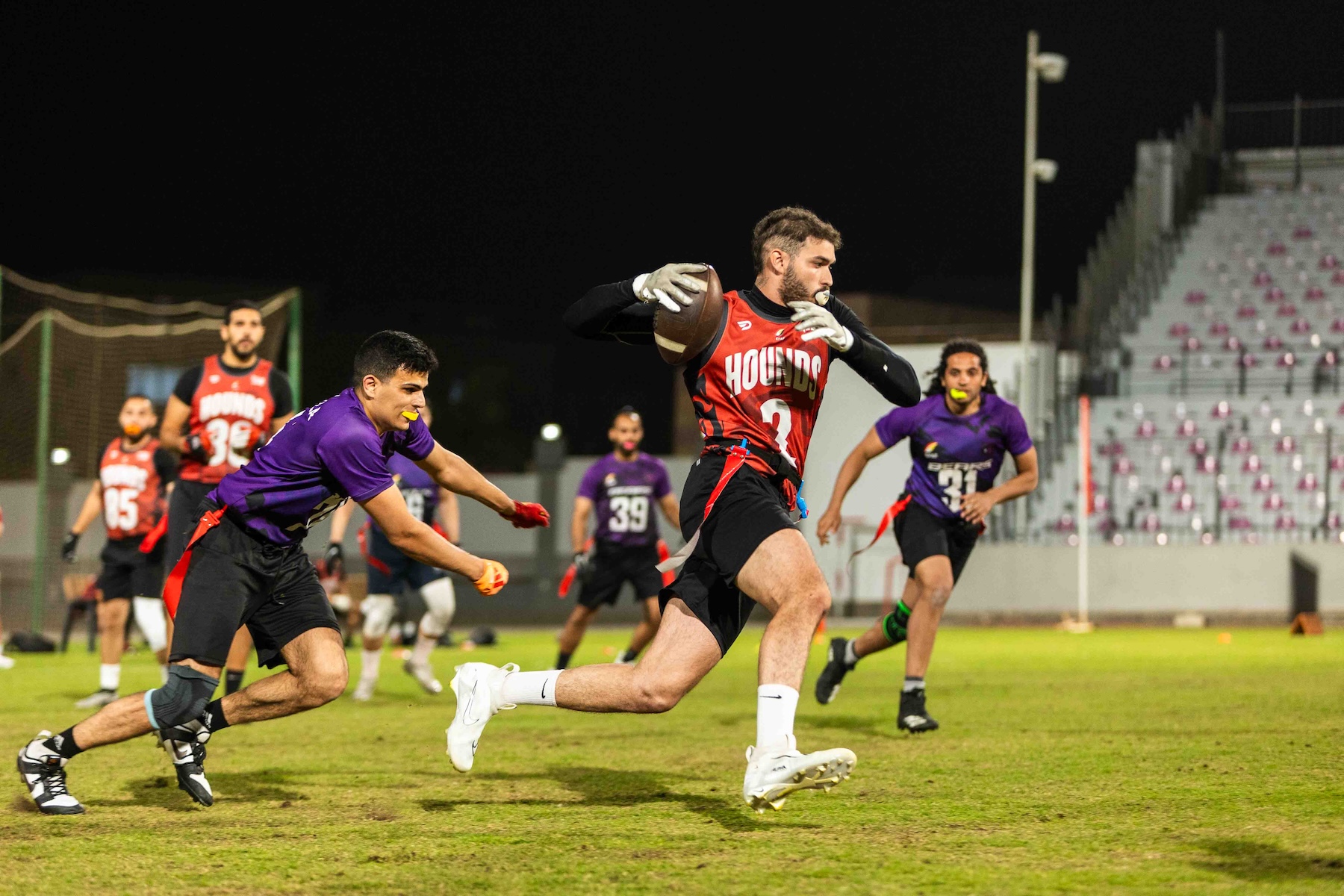
Hosting a tournament can be a double-edged sword. When Egypt welcomes nations from across Africa to the inaugural IFAF Africa Continental Championships, one on hand home field advantage might give them a perceived edge, but on the other, the weight of expectation can weigh heavily on the hosts.
Ahmed Sherif Swar will lead the hopes of his nation from June 20-21 as the head coach of Egypt’s men’s national team. The former tackle and flag player, who transitioned to coaching the sport that now thrusts his country under the spotlight is excited for the challenge ahead.
“It’s a huge honor to be part of something historic, especially on home soil,” said Coach Swar. “The pride is there, but so is the pressure. You want to represent Egypt well and inspire others locally to take the sport seriously. That said, we’re focused on execution and improvement. The results will follow if we stick to our game.”
Unlike teams competing at the continental tournaments across the Americas, Asia-Oceania and Europe, those that arrive in Cairo to contest the African crown next month are relative newcomers to the international stage. National team squads are in their infancy, so Egypt has mainly relied on recent performances and stats from the country’s established flag leagues to evaluate talent alongside a series of tryouts.
“That gave us a solid foundation for evaluating player performance over time,” explains Swar. “In addition, recommendations from club coaches played a key role in identifying standout athletes, especially those who demonstrate leadership, adaptability, and strong football IQ.
“Time is the biggest challenge. You’re building not just a playbook, but a culture - chemistry, trust, communication - all in a compressed timeline. It’s tough to get everyone aligned quickly, especially when players come from different club systems with varying terminology and coaching styles. But it’s also an opportunity to unify around a common goal.”
The majority of Egypt’s men’s national team hail from the Greater Cairo area and have gravitated to flag football from numerous sporting backgrounds.
“We’ve seen players coming from basketball, handball, and track and field especially and those athletes tend to adapt well to flag football because of their agility, coordination, and spatial awareness,” says Swar.
Little is known of prospective opponents with only Cameroon having participated at the 2024 IFAF Flag Football World Championships in Finland. When the draw to determine the tournament schedule is made during the buildup to Africa Flag 2025, Egypt will rely more on their own preparation than the ability of their opposition.
“Scouting isn’t an option the way it is in more established tournaments, so we focus on preparing our fundamentals and being flexible in-game,” says Swar. “We’ve emphasized situational awareness and quick adjustments. We also study general tendencies from countries with similar sporting cultures to get a sense of what we might face.”
Coach Swar expects his team to be balanced but believes that his squad’s speed and communication on defense will stand out, while offensively, they will rely on timing and decision-making rather than just athleticism.
“My philosophy is to build smart, adaptable players who understand the full field, not just their role,” he explains. “It’s about playing with intent.
“Short-term, we want to establish a competitive standard at the African level. Long-term, it’s about creating a sustainable pipeline of players, coaches, systems that keeps Egypt in the conversation internationally.
“We want flag football to be more than just a moment here. We want it to stick and, yes, target the Olympics for sure.”