


American football continues to gain ground in Nigeria and carrying the torch for tackle and flag football in the nation known as the Giant of Africa ultimately rests with the Nigerian American Football Association (NAFA), led by its president Babajide ‘Baba’ Akaredolu.
Many NFL players of Nigerian descent have created interest in the sport their home country, among them Baltimore Ravens wide receiver Nelson Agholor, who was born in Lagos. Agholor moved to the United States when he was five years old, and won Super Bowl LII with the Philadelphia Eagles, making 9 receptions for 84 yards in the title game.
Such successes at the highest level of the game have served as a catalyst for Nigerians to step onto the gridiron with flag football becoming established in schools and local leagues alongside tackle programs that began in 2011.
With the inaugural IFAF African Flag Football Continental Championships scheduled for this summer, NAFA sees the opportunity to compete on the tournament stage as key to advancing an already burgeoning program.
“We are growing organically,” explains Baba. “We've taken our time with flag football with self-funded initiatives, but the growth is there with strong potential.
“NFL Flag coming to Nigeria in June opened the doors to our relationship with the Cleveland Browns (who have NFL marketing rights in the country) and now we're ready to go for the big time to properly build out a national team. Then we come to really compete, so in 2025 Nigeria is going to show you we can play.”
Among the players currently engaged in flag football, there is an equal balance among male and female participation. Nigeria has 36 states with NAFA aiming to increase its current presence in 13 states to 20 by 2030.
Growth ultimately presents challenges that are familiar among all within the international American football community who have grown the game in their respective nations.
“Exposure and funding are the biggest things,” says Baba. “You're competing against the Goliath, which is soccer, and the big banks and sponsors are working with them and with sports that have been established for a long time, with basketball and golf, and with polo.”
Baba has taken inspiration from his own journey into the world of American football and ultimately the formation of Nigeria’s federation to take on the challenge of raising the profile and appeal of NAFA initiatives. Back in 2005 he witnessed his first college football game, which got him hooked when Texas beat USC in the 2006 Rose Bowl.
“I was so intrigued by the sport, so I just started to play two hand touch and then started playing intramurals at the university,” he says. “Then when I moved back home to Nigeria, we set up a league. As the sport started to grow, we knew we needed to bring more structure, and it morphed into a federation.
“We started playing flag football and decided that if we wanted this game to grow, we needed to embrace all platforms. If we have two million people playing flag football, only five percent need to play tackle football, and everything will exponentially grow fast.”
The onset of COVID slowed a plan conceived in 2019 before NAFA focused on high school initiatives, which have since seen 16,000 mainly 11th and 12th graders enrolled in a flag football program.
“They’re about to graduate from high school, so they play in our competition and then move to graduate school and can play in two leagues in the country and each has about 450 players,” says Baba. “Now we are now suddenly the ones that have this pipeline of talent and then you see people will watch and appreciate the appeal of our sport. That creates a lot of exposure and hopefully funding as well.
“The biggest advantage with flag has been the barrier to entry being almost zero. We can take an existing soccer field, give the kids flags and a ball and in two weeks they are running around playing.
“That has helped the exponential growth because it's so easy to play. You just see that connection with five people on the field. These kids are learning quickly and once you have good quarterbacks, they’re watching videos on YouTube to find plays and take charge of things.”
“The way they pick up the game now is much quicker than how I did and with the barrier to entry low, our challenge as an organization will be how to handle so many people wanting to play.”
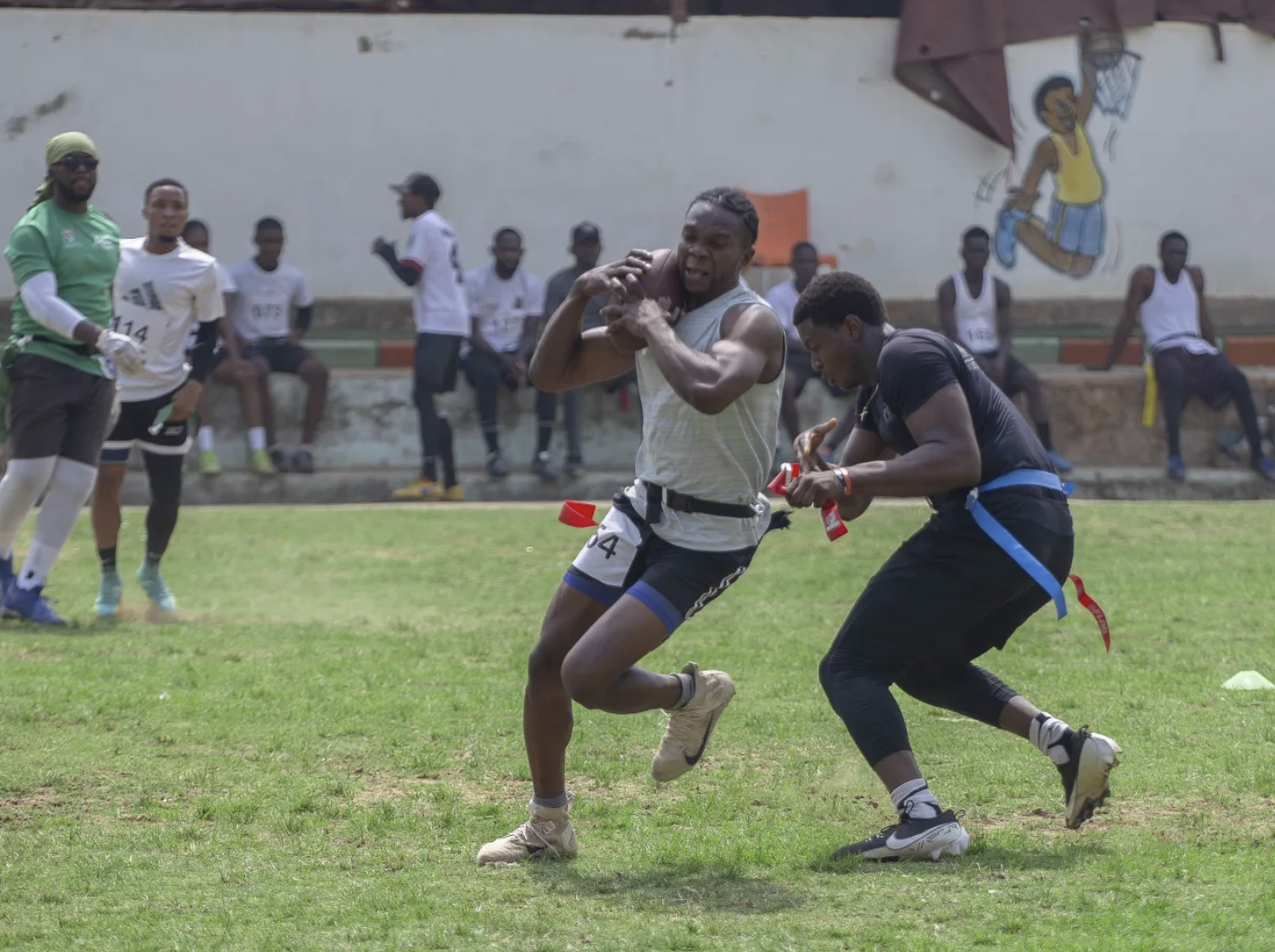
Nigeria’s first steps towards participating in international competition came this week when NAFA hosted tryouts for its men’s and women’s national teams at the Elegbata Sports Complex in Lagos.
Photo: NAFA