



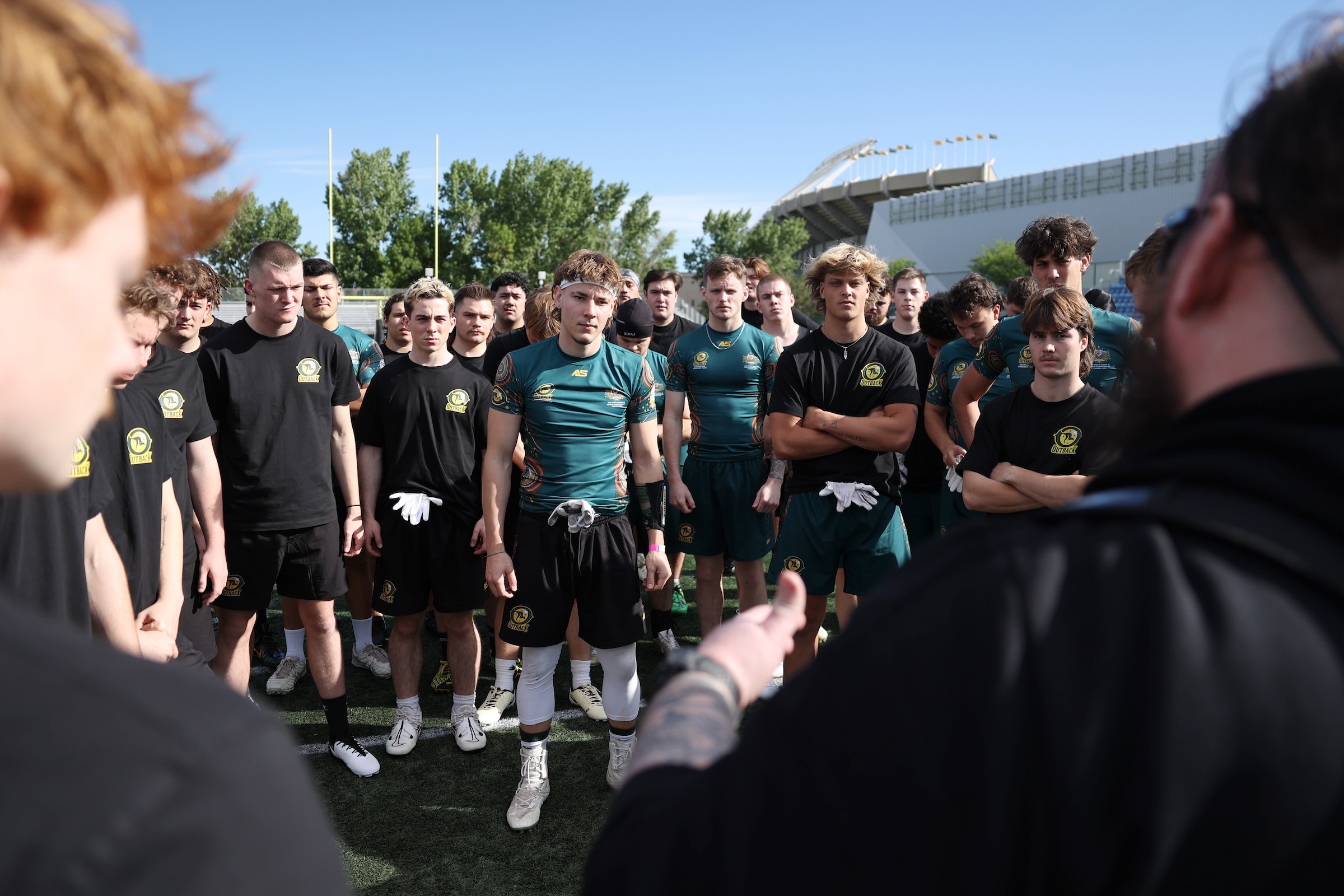
Australia have traveled further than any nation competing at this month’s IFAF U20s World Junior Championships and were the first arrivals in Alberta when they touched down on Friday. They were also first onto the practice field, put through their paces by head coach Mitch Woellner and his staff at Clarke Stadium on Saturday.
Next weekend on that same field, Australia will take on Japan at 4pm local time on Saturday, June 22. The game will be streamed live on IFAF.TV.
More than 13,000km separates the team’s departure city of Sydney and the Alberta capital of Edmonton which plays host to 12 games being played over three game days from June 22-30. That unenviable distance and significant travel time are not the only challenges the Outback squad has faced in preparation to take on the world.
Woellner only recently stepped up to take on the role of head coach having originally been recruited as Australia’s defensive coordinator. Time has been of the essence in making sure the Aussies are ready to challenge Japan for a semi-final meeting against either the United States or Panama. The last time the two nations met, Japan won the battle for fifth place 51-14, at the 2018 IFAF World Junior Championships in Mexico.
“The building blocks that were already in place meant that I could continue the vision that was established within the program right off the bat,” explained Woellner. “We’ve been in the process of sort of upgrading and trying to get to where we need to be.
“We’re under no illusions that we’re regarded as an underdog and our view is that we’re working hard to improve. The expectation is that we can have the capacity to compete at this level and the focus for us is to develop fundamentally sound footballers and put them in situations where they’re going to be able to flourish.”
Woellner’s mission with the Outback squad extends beyond the playing field. This is about more than traveling across continents to take on the world in Canada.
“We talk a lot about the role of football within life and how that exists, and I think it’s such a great learning tool for young men, especially in this day and age,” he explains. “The game forces you to think so quickly and in impulse driven young men, giving them models to be able to assess risk and make really good decisions with very little time can only be a good thing in their life in general.”
In prior IFAF World Junior Championships, Australia have participated twice, winning two games against hosts China by scores of 72-0 and 74-0 in 2016. Last time around in Mexico in 2018 the Outback squad lost 39-0 to USA, suffered a close 19-6 defeat to Sweden and went down 51-14 to Japan. Back in 2009 they fell to New Zealand in a regional qualifier for the inaugural competition. They face a tough challenge in Alberta and are setting goals of a broad nature to help better the game back home while they look to upset opponents in Canada.
“I think going into a tournament like this there’s - I don’t even want to say disparity between teams - but there’s some unknowns between teams,” says Woellner. “So, you can’t just go in there and say we’ve got to win every single game or that we’ve got to come back as champions. Obviously, every team wants that, but you’ve got to go in there with some kind of goals that are right for the players and the program as a whole and for what this can do for gridiron in Australia.”
That vision started several months ago with player recruitment and camps in five territories across the significant Australian land mass. The next step is the pre-tournament camp taking place with the Aussies having arrived in Edmonton eight days prior to kickoff.
“It’s such an incredible challenge on so many levels, which is why we’re coming in early to try and get into a camp and start to work with these guys in ways that can help them come together as a team,” Woellner explains. “Geography presents a challenge, not that other teams don’t experience that by any means, but culturally across Australia each state has its own nuances. The main similarity is that the kids just love football and American football is a north star for a lot of these kids. We’ve been doing a lot of online team connectedness stuff and they’re getting to know one another and really trying to build that rapport prior.”
Once that desired chemistry has pushed aside the inevitable effects of jetlag during the upcoming week of practices and acclimatizing to Edmonton, Australia will be ready to line up against Japan.
2024 IFAF World Junior Championships Schedule Saturday, June 22 Commonwealth Stadium 12pm USA vs. Panama (Game 2) 5pm Canada vs. Brazil (Game 4)
Clarke Stadium 11am Canada 2 vs. Austria (Game 1) 4pm Japan vs. Australia (Game 3)
Wednesday, June 26
Commonwealth Stadium 12pm W2 vs. W3 5pm W1 vs. W4
Clarke Stadium 11am L2 vs. L3 4pm L1 vs. L4
Sunday, June 30 Commonwealth Stadium 12pm Bronze Medal Game 5pm Gold Medal Game
Clarke Stadium 11am Seventh & Eighth Place Game 4pm Fifth & Sixth Place Game
Past winners and host cities 2009: Canton, Ohio, USA: United States 41, Canada 3 2012: Austin, Texas, USA: Canada 23, United States 17 2014: Kuwait City, Kuwait: United States 40, Canada 17 2016: Harbin, China: Canada 24, United States 6 2018: Mexico City, Mexico: Canada 14, Mexico 7
Photo: James Maclennan