



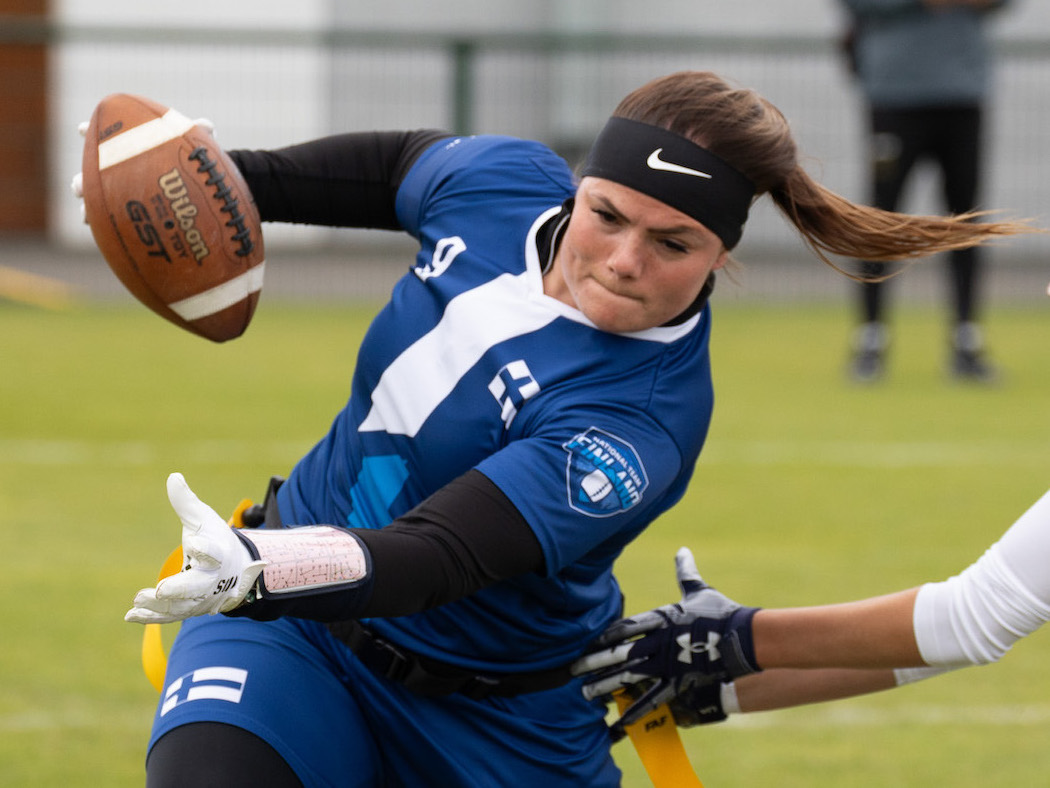
Expectations are never greater for a team at world championships than for the host nation.
Regardless of world rankings or previous performances, home field advantage and the buzz of excitement that comes with hosting tends to lift teams. Finland is no exception and their men’s and women’s teams will hope to continue an upward trajectory following on from performances at IFAF tournaments in 2021 and 2023.
“We’re hosting the World Championships, so we want to be competitive,” says men’s head coach Tuomas Heikkinen.
Heikkinen’s men’s team rank joint 22nd in the world alongside Ukraine having ventured into the unknown for the 2021 World Championships. They then traveled to Ireland in August short of a full 12-man roster due to players representing club teams back home during the ongoing Finnish Maple League season. They still returned home with two wins and came very close to upsetting World Games silver medalists Italy, losing by only three points.
Heikkinen is a Finnish American football Hall of Famer having won almost every honor in the game at domestic and international level as both a player and a coach. He is no flag football rookie having been exposed to the sport thirty years ago.
“I became familiar with flag football back in the early 90s,” he explains. “I was working as a teacher for a long time and at the Finnish federation, where I was trying to encourage flag football in schools. It was semi contact and a little bit of pushing and shoving was allowed at the line of scrimmage, so a different version of today’s game.
“When five-on-five flag football came to Finland they handed equipment to schools and the new game to me was totally exciting because the tackle footballers all wanted contact, but now there was no line play at all and no contact. There are no formation rules but there's a lot of room for creativity and for ball skills to develop.
“When I went back to do my master’s at the University of Jyväskylä I wrote a thesis on flag football as a tool of teaching social skills. So, I’ve been in and out of the sport throughout my football career.”
Finland put the fortunes of their men’s team in Heikkinen’s hands three years ago. Despite the challenges of most of Finland’s traditional sports embracing physical contact, he set about transferring athletes’ skills to benefit flag football.
“When this opportunity came along, I stepped down from the national (tackle) team and the chance to become involved in the basics of flag again and go to the World Championships in Israel was too good to refuse,” he added.
“Israel was a huge learning curve for us because we went out there with former or current football players with tackle football skills and they suddenly saw the game of flag football at the top level and how it differs from what they’re used to. Since then, we've been trying to build and create our own style of play.
“I froze at first when some of the players went across the middle to make a catch at the world championships because it’s so different and they’re not going to get hit by two big linebackers, but your instinct tells you to expect that.
“I think the best way to learn is to play, learning by doing. It raises questions and then you try to find the answers.”
The inclusion of flag football as a sport at the 2028 Olympic Games in Los Angeles serves as a valuable recruiting tool as Finland looks to attract the nation’s top football players and athletes from other sports for both the men’s and women’s teams.
“We have an established quarterback who played for the national (tackle) team against Austria and then against Sweden, but you have to teach them things that are different about flag,” he says. “The route running is similar for the receivers and defensive backs are reading the same way but there's really no use for the big lineman which we’ve always had a lot of in Finland. They have to take into account that first of all they’re no longer allowed to hit anyone and to realize that they will not get hit either.
“Also, the field is really small, so a safety can easily cover the whole field and doesn't have to think about the same sort of coverages. It's an adjustment that takes a while for a football athlete, but I think it happens pretty naturally for a good football player.
“We need to try to make people who are athletes who maybe have reached the roof in their main sport to understand that that they already have all the necessary tools to learn how to play. But it's very hard for a high-level athlete to accept the idea that they could move to another sport and compete a high level.
“Our best young athletes in Finland are in ice hockey right now and then they know by the age of 17 or 18 if they’re going to make it. They might come to tackle football because they like the physicality but then again hockey is very much about skill so they can also come to flag football.”
The Finnish women’s flag national team have tasted success on the international stage. Back in 2004 winning they won the IFAF Flag Football World Championships silver medal in France in a title game loss to Mexico, and bronze two years later in Korea, beating Sweden 45-33.
Currently ranked joint 19th in the world alongside Denmark, Finland’s women lost all four games in a tough 2021 IFAF World Championship group featuring eventual gold medalists USA and European champions Spain. Victory came in the game for 17th place as Chile were blanked 32-0.
Last summer at the European continental championships, Finland’s women were again grouped with Spain and posted a 2-3 record, beating Switzerland and hosts Ireland. Great Britain proved too strong in the knockout stages, as did Austria in the placement round.
When Finland’s men and women proudly line up in Lahti from August 27-30, they just might be one of those wild card teams that thrive on the magic of playing on home soil.
Photo: Ian Humes