


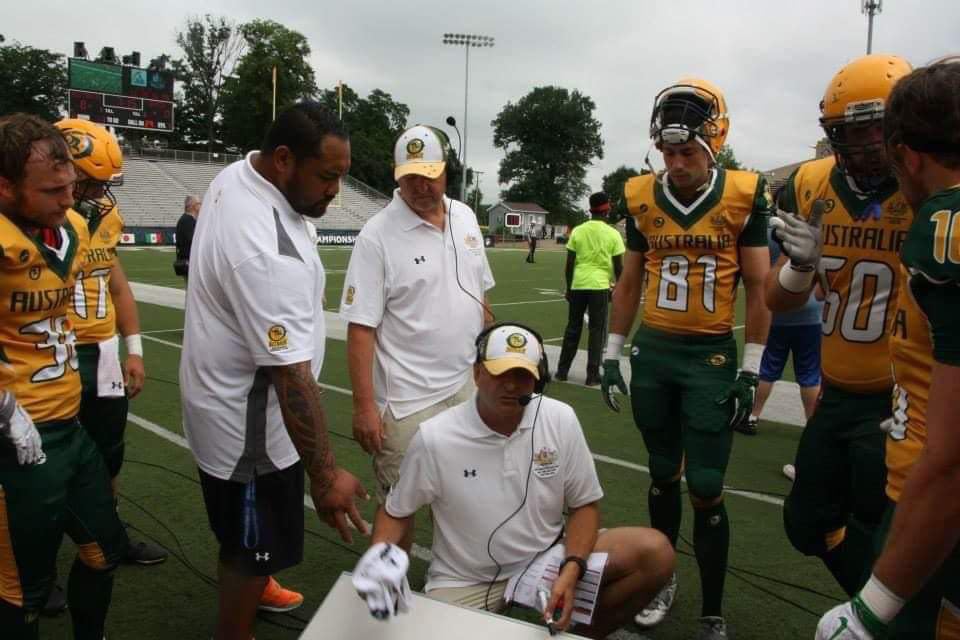
By Michael Preston Australia might be relative newcomers to the international flag football arena, but in the head coach of their women’s team, Paul Manera, they are led by an icon of the game down under.
Known more commonly in Australia as gridiron rather than American football, the sport caught on as it did in many corners of the world in the 1980s and Paul was there at the beginning. An early pioneer of the sport, he was the first Australian to earn a scholarship to a Division I American college football program and then returned home to pass on knowledge and advice to those eager to follow in his footsteps.
Since taking his first foray into coaching as a student assistant at his alma mater the University of Hawaii, Paul has coached with too many teams to mention. Among the highlights are the Australian men’s national team, New South Wales Wolfpack state team, Northern Sydney Rebels the IFAF World Team, and the Obic Seagulls in Japan.
He has been coaching flag football for 16 years in schools and continues to spread word of its appeal through the company he runs with his wife Elissa, Bring It On Sports. When the role of national team head coach for the team entering the IFAF Asia/Oceania Flag Football Championships in Malaysia was advertised, Paul was quick to apply.
“It’s exciting times for flag,” he says.
Back in March, Paul answered a request from neighbors New Zealand to visit and play flag football games against a New South Wales team, and quickly increased participation to entries from across the country. Soon an international tournament was in place and by July, eight men’s and five women’s teams from Western Australia, Queensland, the Australian Capital Territory, and Victoria were also signed up to participate, along with a Gridiron Australia all star team. From that event the squads that will travel to Malaysia for the continental tournament were selected.
“It’s our first time so we’ll probably be a bit behind the eight-ball compared with other countries,” admits Paul. “Japan have been playing for a few years now and we’ve seen film of them, so I feel out of all the countries there we’ll be the new kids on the block. Our expectations are to go there to compete and be the best we can be and find a lot out about ourselves at the tournament.”
Australia have always excelled on the international stage and will be among the contenders in Kuala Lumpur. The women’s team will lean on some veterans of the women’s national tackle team, who have experience of playing in IFAF world championships. Quarterback Casey Cubis played at the 2017 event in Canada, while fellow signal caller Danielle De Groot represented her nation in Finland last year. Kodie Fuller, Dania Herdman, Marissa Hayes and Pier Pritchard have similar experience.
“The skills are there already in terms of running routes and one on one coverage,” explains Paul when asked what such players bring to the flag team. “The obvious and biggest change from the tackle perspective is that you can’t have contact, so you can’t jam a receiver at the line of scrimmage and things like that.
“Conceptually the game is very similar in terms of trying to find space and getting open, but the blitzers only take a few seconds before they’re tagging the quarterback, so you can’t spend as long in the pocket looking for a pass.”
The story of Paul’s unexpected introduction to the gridiron mirrors that of many around the globe who were unintentionally introduced to the sport.
“Back in the day, the first time I actually watched American football - I think it was the Pittsburgh Steelers who might have been playing the Dallas Cowboys - I turned the TV off after about 30 seconds,” he laughs. “I said, ‘this game so slow I’m bored’ and it just was actually probably during a time out.
“A couple of years later it was on television again and there was a commentator who mentioned how you had four downs basically to make ten yards and I thought ‘ok, now I know what's going on,’ so I started watching the game. That was when the Oakland Raiders beat the Philadelphia Eagles in the Super Bowl in 1981 and I’ve been hooked on it ever since.
“I was playing rugby at that time. I would have been 12 or 13 years of age and back then they only showed the playoffs and the Super Bowl. I wrote a letter to the television station and asked if they could get the 49ers and Raiders out here to Australia to play a game as I thought it would be really good to promote the sport. They never replied to my letter.”
A few years later, the avid watcher became a rookie player, albeit on a very rudimentary level initially.
“I started my apprenticeship at the age of 15 to be an electrician because I’d left high school at the end of the tenth grade and I was at a trade school,” Paul explains. “I heard two of my workmates talking about gridiron and when they asked if I was going to the tryouts my ears just pricked up.”
After the Raiders had beaten the Redskins in Super Bowl XVIII, the 17-year-old joined about 300 other enthusiasts in Parramatta Park in Sydney one Saturday. Trialists were split into groups based on where they lived in the sprawling city and Paul was among those recruited to his most local team, the Fairfield Argonauts.
“It was 1984 and we played without helmets and shoulder pads!” he remembers, somewhat disbelieving. “Basically, what we would do is get old couches and sofas and stuff like that make and make up our own shoulder pads. We looked like Michelin men and the real fancy guys, the posh people who thought they’d be really trendy, got kickboxing helmets and they wore them. They looked like Swiss cheese helmets. That was our first year.”
A visit to watch the University of Hawaii in action proved the catalyst for a dream to play football for the Rainbow Warriors and by 1987 offensive coordinator Paul Johnson had arranged a tryout for Paul at Itawamba Community College in Fulton, Mississippi. From there the dream became a reality. The former tight end and linebacker with the Bondi Raiders went on to play as an offensive lineman on a full scholarship at Hawaii from 1989 to 1991.
“After I graduated, I decided to come home to coach because I just felt compelled to give back to the game here,” Paul explains. “It was such an awesome experience for someone like myself, being the first Australian local gridiron player to actually go overseas and play, and I just felt I wanted to help others have that experience, that opportunity.”
Among the countless hundreds of players who have since benefitted from Paul’s knowledge and encouragement are NFL players, among them Jacksonville Jaguars defensive end Adam Gotsis, who is now in his eighth season. Paul still has a screenshot of an old message from Gotsis asking for advice on how he might one day become a NFL player, before he stood out at Georgia Tech and was then selected in the second round of the NFL Draft by the Denver Broncos.
Others have followed in the college and pro ranks, including defensive end Matt Leo, who is now a defensive coach with the Eagles.
“I’m really proud when I see the success those guys have had,” says Paul. “I just pointed them in the right direction. Regardless of whether or not they make it to the NFL, they get an education and the experience of a lifetime.”